Why CNC Gives Luthiers a Competitive Edge?
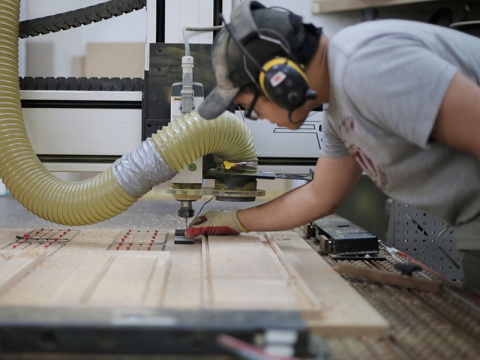
Traditional guitar building demands hundreds of hours per instrument. A single acoustic guitar neck, hand-carved and shaped, can take 3 full days. With a Router madeira CNC, that same neck is machined in under 4 hours including setup. This speed advantage compounds across batch runs, allowing small workshops to fulfil custom orders and produce inventory simultaneously.
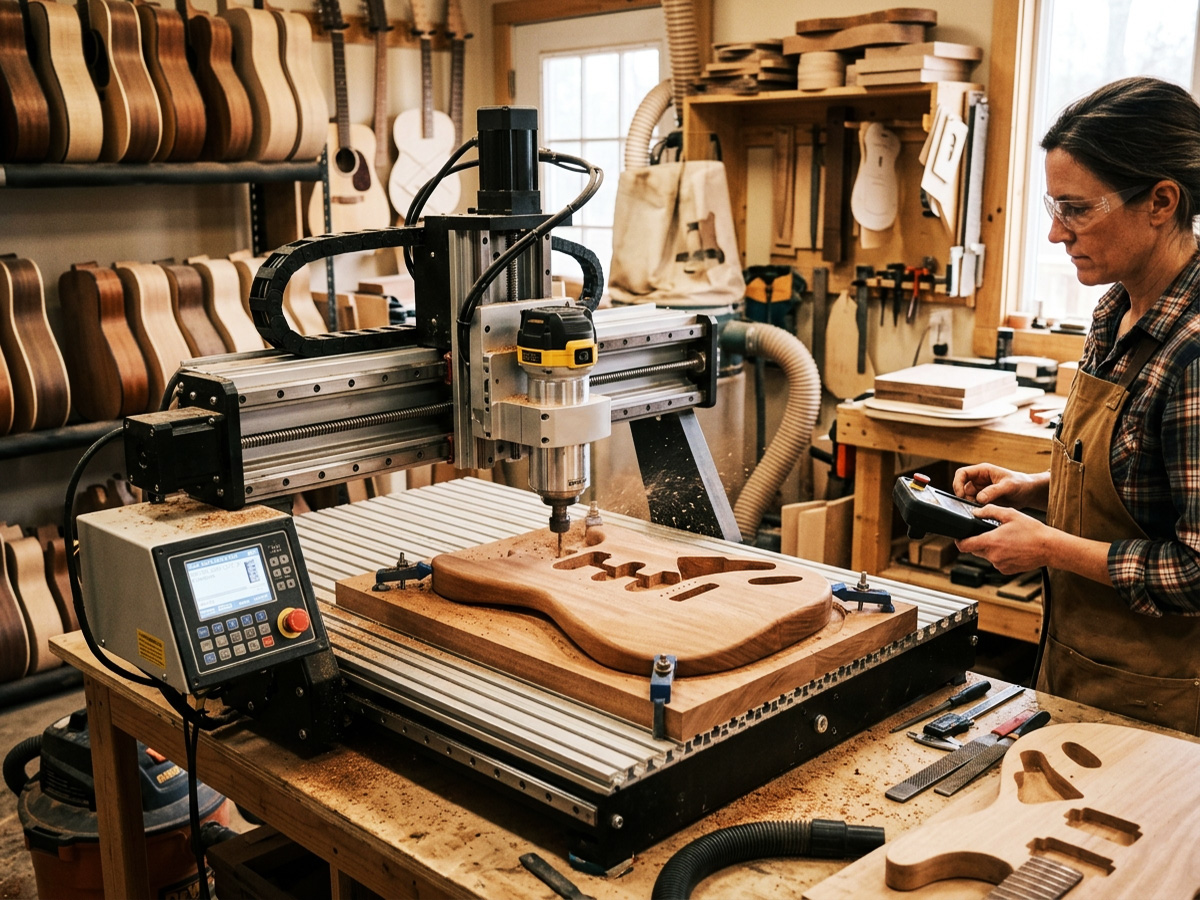
CNC carving also eliminates the inconsistency that plagues hand-built instruments. Every cavity, radius, and contour is replicated from verified CAD files, so the 10th guitar off the line sounds and plays identically to the first.
| Medição | Feito à mão | CNC-Routed |
|---|---|---|
| Body shaping time | 6 – 8 horas | 45 - 90 minutos |
| Neck carving time | 2 – 3 dias | 3 – 4 horas |
| Tolerância dimensional | ±0.5 mm típico | ±0.05 mm alcançável |
| Taxa de desperdício de material | 15-25% | 5-10% |
| Consistência de lote | Variável | Identical per CAD file |
Growing Demand for CNC-Made Guitar Parts
The global guitar market was valued at approximately $12.7 billion in 2025 and is projected to grow at a compound annual growth rate of roughly 7.5% through the early 2030s. Custom and boutique instruments represent one of the fastest-expanding segments, with order volumes at custom shops reaching unprecedented levels.
Online marketplaces like Reverb, Etsy, and eBay have made it remarkably easy for small builders to reach global buyers. Used and boutique guitar sales alone represent a multi-billion-dollar annual market growing at over 5% por ano.
• Roughly 45–49% of new guitar players since 2020 are female, dramatically expanding the buyer base
• Entry-level guitars under $200 account for about 60% of unit sales creating huge demand for affordable, well-made components
• Online guitar sales now represent 38–40% of all U.S. guitar purchases
• Customization demand has surged, with buyers seeking personalized body shapes, inlays, and finishes
What You Can Make and Sell: Product Catalog with Pricing?
A CNC guitar-making business is not limited to complete instruments. Component sales, accessories, and supplementary products open multiple revenue streams. Below is a product catalog with approximate per-unit pricing for CNC-produced items.
| Produto | Material | Faixa de preço | Canal de vendas |
|---|---|---|---|
| Electric guitar body (blank) | Alder, Ash, Basswood | $ $ 60- 150 | Reverb, eBay, direct orders |
| Acoustic guitar body kit | Spruce, Mahogany | $ $ 120- 300 | Luthier supply retailers |
| Guitar neck (maple/rosewood) | Ácer, Mogno | $ $ 50- 180 | Reverb, Etsy, wholesale |
| Fretboard / fingerboard | Ebony, Rosewood, Maple | $ $ 20- 60 | Luthier supply, direct |
| Headstock overlay / veneer | Ebony, Exotic hardwoods | $ $ 8- 25 | Etsy, luthier forums |
| Custom inlays (fretboard/rosette) | MOP, Abalone, Acrylic | $ $ 15- 80 | Direct, Reverb, Etsy |
| Escudos de proteção | Acrylic, Wood, Celluloid | $ $ 10- 40 | Amazon, Reverb, direct |
| Guitar picks (custom branded) | Acrylic, Wood, Horn | US $ 2– US $ 8 cada | Etsy, band merch, wholesale |
| Guitar stands / wall hangers | Hardwood, Plywood | $ $ 25- 75 | Amazon, Etsy, music retailers |
| Custom guitar case inserts | Foam + Plywood shell | $ $ 40- 120 | Direct, Reverb |
| Jigs & templates for builders | MDF, Acrílico | $ $ 15- 50 | Luthier forums, Etsy |
Choosing the Right CNC Router for Guitar Building
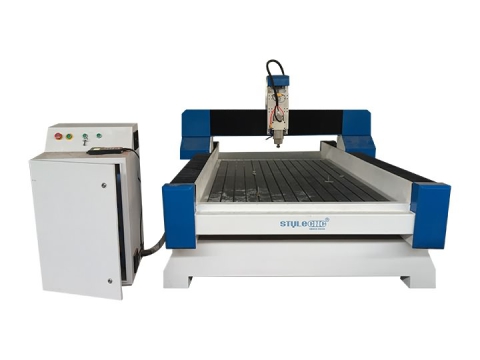
Selecting the right machine depends on your production volume, workspace, and budget. A compact 600×900 mm router handles individual guitar bodies and necks well, while a full-size 4x8 Router madeira CNC allows you to nest multiple parts on a single sheet, maximizing throughput for batch production.
For shops that cut various profiles (body cavities, neck pockets, inlay pockets), an ATC CNC router with automatic tool changer eliminates manual bit swaps and saves significant time across multi-operation runs. A 2.2–3.0 kW spindle provides adequate power for hardwoods like maple and mahogany. For larger commercial operations, a 4.5 kW or higher spindle paired with vacuum hold-down delivers industrial-grade performance.
Recommended Machine Configurations
| Escala | Área de trabalho | Fuso | Mais Adequada Para |
|---|---|---|---|
| Hobby / Startup | × 600 900 mm | 1.5–2.2 kW | Single body/neck production, prototyping |
| Pequena Oficina | × 1300 2500 mm | 3.0–4.5 kW | Batch bodies, nested cutting, jig making |
| Oficina de Produção | 1500 × 3000 mm+ | 4.5–9.0 kW + ATC | High-volume manufacturing, multi-part nesting |
Material Recommendations for CNC Guitar Parts
Tonewood selection directly affects sound quality, workability, and retail value. Below are the most common materials used in CNC guitar production, along with their typical applications.
• Alder / Basswood: Lightweight, easy to machine, excellent for electric guitar bodies. Favored by Fender-style builders.
• Ash (Swamp Ash): Open-grain, bright tone. Popular for Telecaster and Stratocaster-style builds.
• Mahogany: Warm, rich tone with excellent sustain. Standard for Les Paul-style bodies and acoustic guitar backs/sides.
• Maple: Dense and bright. Used for necks, fretboards, and body tops. Requires sharp tooling and slower feed rates on CNC.
• Spruce: The go-to soundboard wood for acoustic guitars. Light, stiff, and resonant.
• Ebony / Rosewood: Premium fingerboard woods. Dense and oil-rich use carbide tooling and lower spindle speeds.
Adding Value with Laser Engraving and Inlay Work
Fretboard inlays, rosettes, and headstock logos are high-value additions that set custom guitars apart from mass-produced instruments. A CNC router handles pocket cutting for shell and acrylic inlays, while a máquina de gravação a laser adds intricate decorative engraving, serial numbers, and branded logos directly onto wood, bone, or acrylic surfaces.
Combining a CNC router with a laser expander gives your workshop the capability to offer fully customized instruments at premium price points. Many successful luthier businesses report that custom inlay and engraving services alone generate 20–30% da receita total.
Business ROI: Investment vs. Return Breakdown
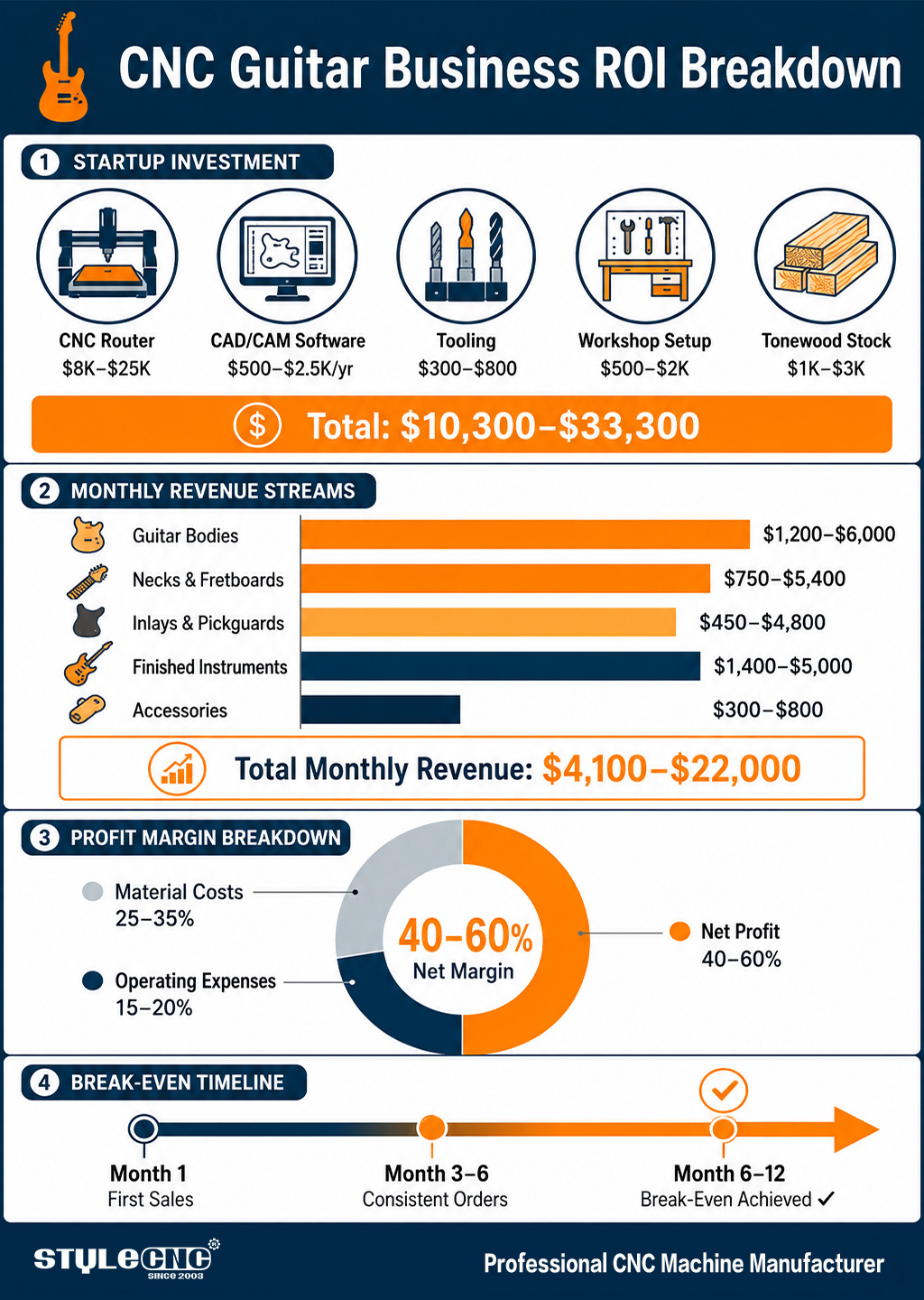
Understanding the financial picture is essential before launching. Here is a realistic ROI projection based on a small workshop producing CNC guitar components and finished instruments.
| Item de investimento | Custo estimado |
|---|---|
| CNC router (3-axis, ATC, 1300×2500 mm) | $ $ 8,000- 25,000 |
| CAD/CAM software (Fusion 360, VCarve, etc.) | US$ 500 a US$ 2,500 por ano |
| Tooling (end mills, ball nose, V-bits) | $ $ 300- 800 |
| Dust collection and workshop setup | $ $ 500- 2,000 |
| Initial tonewood stock | $ $ 1,000- 3,000 |
| Investimento total em startups | $ $ 10,300- 33,300 |
Monthly Revenue Projection (Small Workshop)
| Fluxo de receitas | Units / Month | Receita mensal |
|---|---|---|
| Guitar bodies (electric) | 20-40 | $ $ 1,200- 6,000 |
| Necks and fretboards | 15-30 | $ $ 750- 5,400 |
| Custom inlays and pickguards | 30-60 | $ $ 450- 4,800 |
| Finished instruments | 2-5 | $ $ 1,400- 5,000 |
| Accessories (picks, stands, jigs) | 50-100 + | $ $ 300- 800 |
| Total Estimated Monthly Revenue | - | $ $ 4,100- 22,000 |
With material costs averaging 25–35% of revenue and operating expenses around 15–20%, net profit margins of 40–60% are achievable for well-managed CNC guitar businesses. Most workshops reach break-even within 6–12 months of consistent production.
How to Reach Your Buyers
Selling CNC-made guitar parts and instruments requires a multi-channel approach. Here are the most effective strategies builders use to find and retain customers.
✓ Reverb.com – The largest dedicated marketplace for musical instruments and parts. Low listing fees, built-in buyer trust, and strong SEO for guitar parts.
✓ Etsy – Ideal for custom inlays, branded picks, unique headstock overlays, and artisan accessories.
✓ eBay / Amazon – High volume for standardized bodies, necks, and hardware kits.
✓ Direct website with Shopify – Build your brand, showcase custom builds, and capture higher margins by selling direct-to-consumer.
✓ Music retailers and distributors – Wholesale partnerships for shops and chains.
✓ Luthier supply communities – Forums like LMI, StewMac community, and social media groups connect you with professional builders who need reliable component suppliers.
Erros comuns a evitar
Starting a CNC guitar business has a learning curve. These are the pitfalls that trip up most new builders:
• Skipping prototyping: Always test-cut in inexpensive poplar or MDF before machining premium tonewoods.
• Wrong feed rates for hardwoods: Dense woods like maple and ebony require slower feed rates and sharp carbide tooling to prevent tear-out.
• Ignoring dust collection: Fine tonewood dust damages spindle bearings and rails. Invest in proper extraction from day one.
• No quality control process: Measure every batch with calipers. Even 0.2 mm drift on a neck pocket affects playability.
• Underpricing your work: Factor in machine time, material, finishing, shipping, and marketplace fees before setting prices.
• Over-relying on CNC alone: Final sanding, fretwork, finishing, and setup remain hand processes. CNC handles rough and precision shaping, not the entire build.
Getting Started: Step-by-Step Checklist
Follow this sequence to move from idea to 1st sales as quickly as possible.
1. Research your niche: electric bodies, acoustic kits, accessories, or all three.
2. Select and order your CNC router. Explore options from the STYLECNC woodworking CNC router catalog to match your budget and production goals.
3. Install CAD/CAM software (Fusion 360, VCarve Pro, or Aspire) and learn guitar-specific toolpaths.
4. Source tonewoods from reputable suppliers (Gilmer Wood, Cook Woods, or local sawmills for reclaimed stock).
5. Prototype your 1st designs in MDF or poplar before committing to premium blanks.
6. Set up seller accounts on Reverb, Etsy, and your own Shopify store.
7. Photograph and list your products with detailed specs, wood species, and CNC precision claims.
8. Build a social media presence (Instagram, YouTube, TikTok) showing your CNC process-build videos, which convert extremely well.
Watch: CNC Router Making a Guitar Body
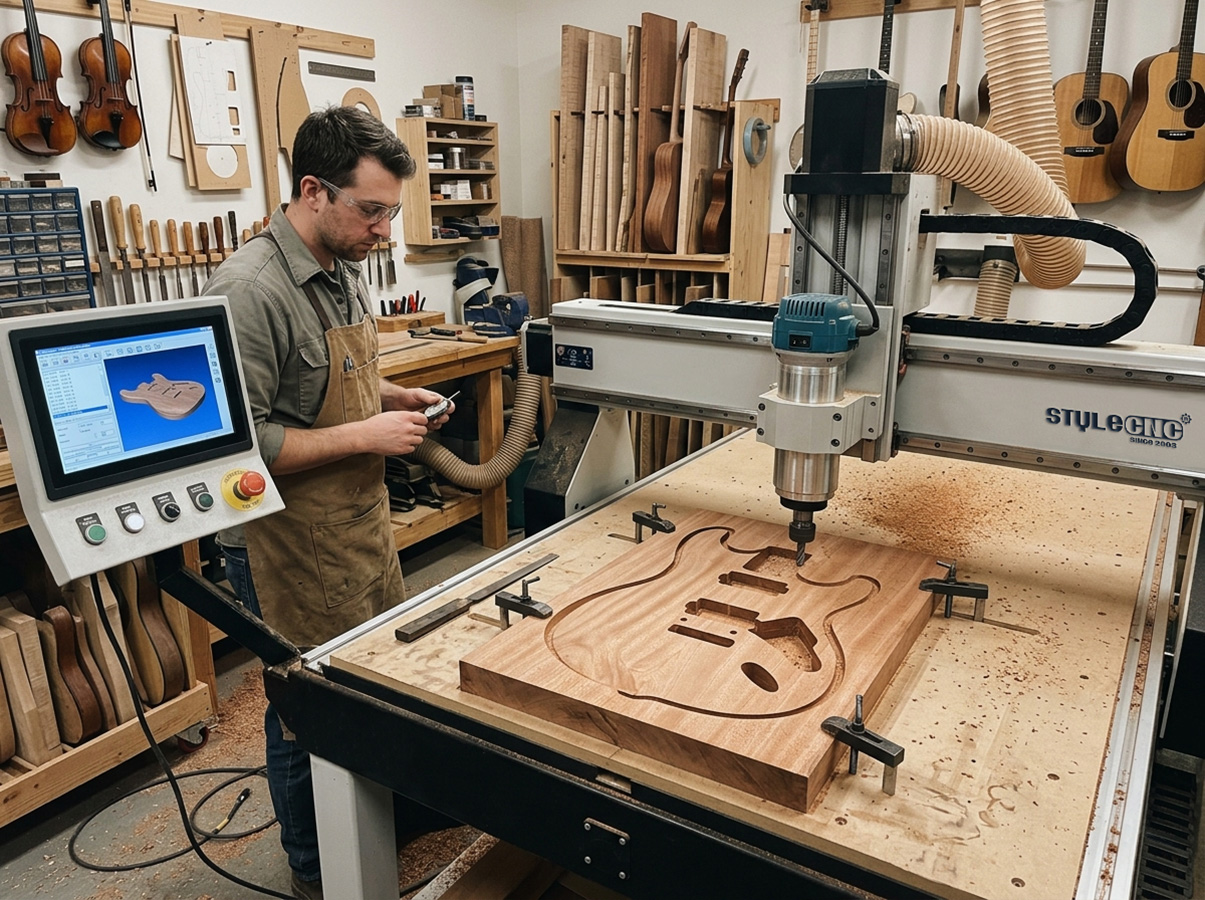
Veja uma STYLECNC router in action, shaping a guitar body from a raw wood blank. View the full video demonstration: CNC Router DIY Guitar Body.
Perguntas frequentes
What size CNC router do I need to make guitars?
A minimum work area of 600×900 mm handles individual bodies and necks. For batch production and sheet nesting, a 1300×2500 mm or larger table is recommended.
How much does it cost to start a CNC guitar making business?
Entry-level setups start around $10,000–$15,000 including the router, software, tooling, and initial materials. Production-grade workshops typically require $20,000–$35,000.
Can I use CNC for acoustic guitars, not just electric?
Yes. CNC routers machine acoustic guitar braces, neck blocks, rosettes, bridge plates, and body molds. Many acoustic luthiers use CNC for all structural components and reserve hand work for voicing and final assembly.
What CAD/CAM software works best for guitar building?
Fusion 360, VCarve Pro, and Aspire are the most popular among guitar builders. Free options like FreeCAD work for basic 2D profiles, but 3D neck carving typically requires Fusion 360 or MeshCAM.
Is CNC guitar building profitable as a side business?
Absolutely. Selling just 10–20 guitar bodies and necks per month on Reverb or Etsy can generate $1,500–$4,000 in revenue with 40–60% margins making it a viable side income alongside a day job.
Does CNC replace hand craftsmanship in guitar making?
No. CNC handles precision shaping, cavity routing, and repetitive tasks. Final sanding, fretwork, finishing, setup, and quality inspection remain essential hand skills that define a builder’s reputation.