The Real Question: Outsource or Own?
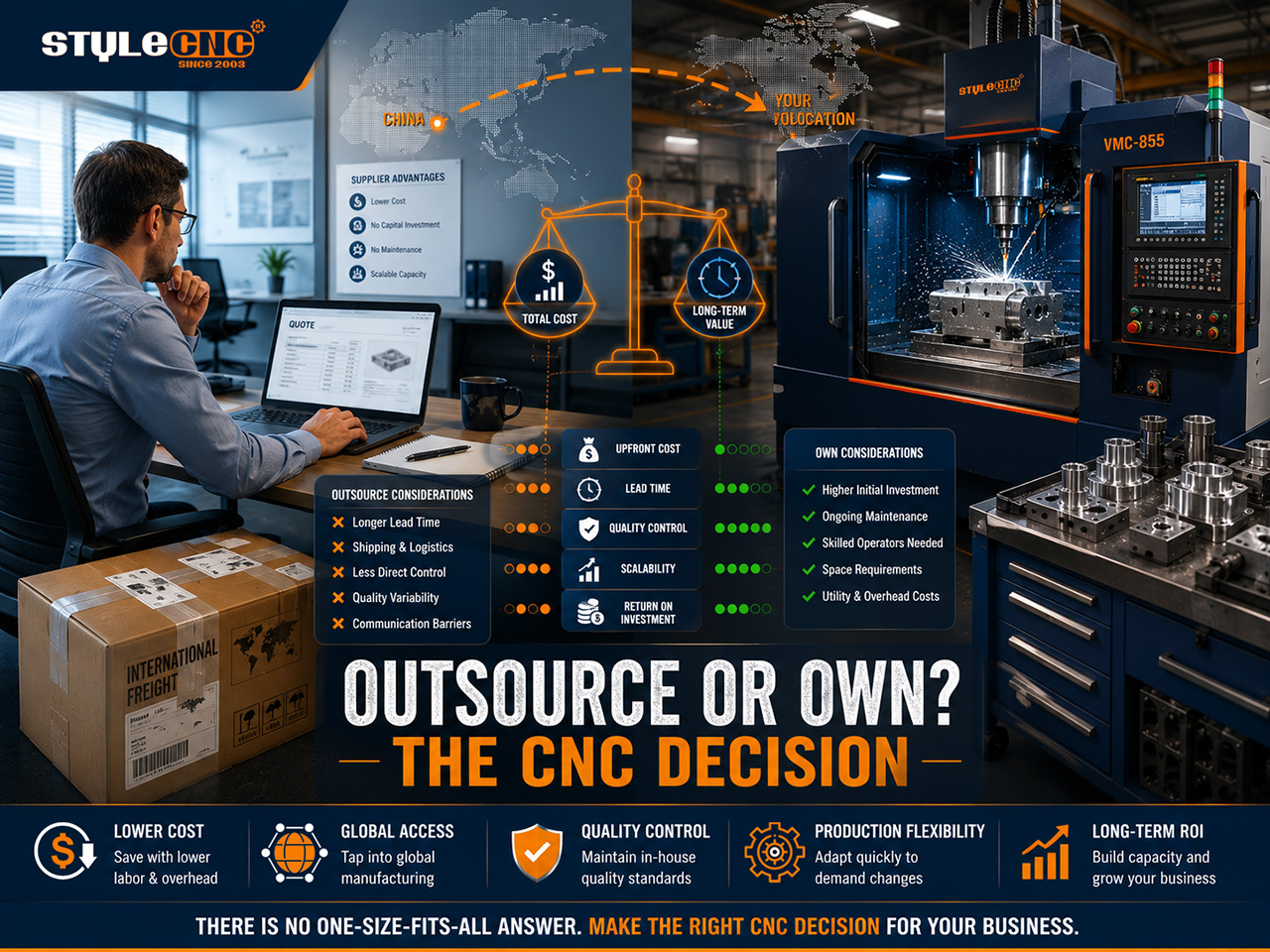
Outsourcing to China CNC machining services typically costs $15 to 55 per part for aluminum brackets versus $60 to 150 in the U.S. Owning your own CNC vertical machining center from a Chinese manufacturer costs $25,000 to 40,000, with break-even against outsourcing at approximately 1,500 to 2,500 parts per year depending on part complexity and current service rates.
The comparison sounds simple, but it hides 3 critical variables that shift the answer: production volume, part variability, and how much you value control. High-volume, repeatable parts favor ownership. Low-volume, prototype, or highly-variable work favors service. The gray zone in the middle is where most buyers actually operate.
A common misconception is that Chinese CNC service is cheap because the machines are cheap. It is not. Machines used in Chinese factories are typically the same brands used in U.S. and European shops, including Fanuc, Mazak, Haas, and comparable Chinese-built industrial machines. The cost difference comes from labor rates, factory overhead, and material supply chains, all of which are structurally lower in China. Buying the machine itself gives you access to the equipment side of that cost advantage.
What Is China CNC Machining Service?
Chinese CNC machining service means uploading a CAD file (STEP, IGES, or Parasolid) to a Chinese factory, receiving a quote within 24 hours, and having finished parts shipped internationally within 2 to 4 weeks including freight.
The service ecosystem has professionalized significantly. Modern Chinese CNC suppliers offer AI-driven instant quoting, Design for Manufacturability (DFM) feedback, ISO 9001 certification, and quality inspection reports. According to industry data, 63.3 percent of Chinese CNC machining demand comes from orders of 50 units or fewer, and 43.3 percent of RFQs are for prototypes of 1 to 5 units. Chinese factories serve small-batch and prototype work as competently as they serve mass production.
Typical CNC processes available include 3-axis milling, 4-axis and 5-axis milling, CNC turning, EDM, wire EDM, Swiss machining, sheet metal fabrication, and post-processing (anodizing, powder coating, brushing, polishing, heat treatment). Materials range from aluminum 6061 and 7075, stainless 304 and 316, brass, copper, tool steel, titanium, and engineering plastics.
China CNC Machining Service: What You Actually Pay
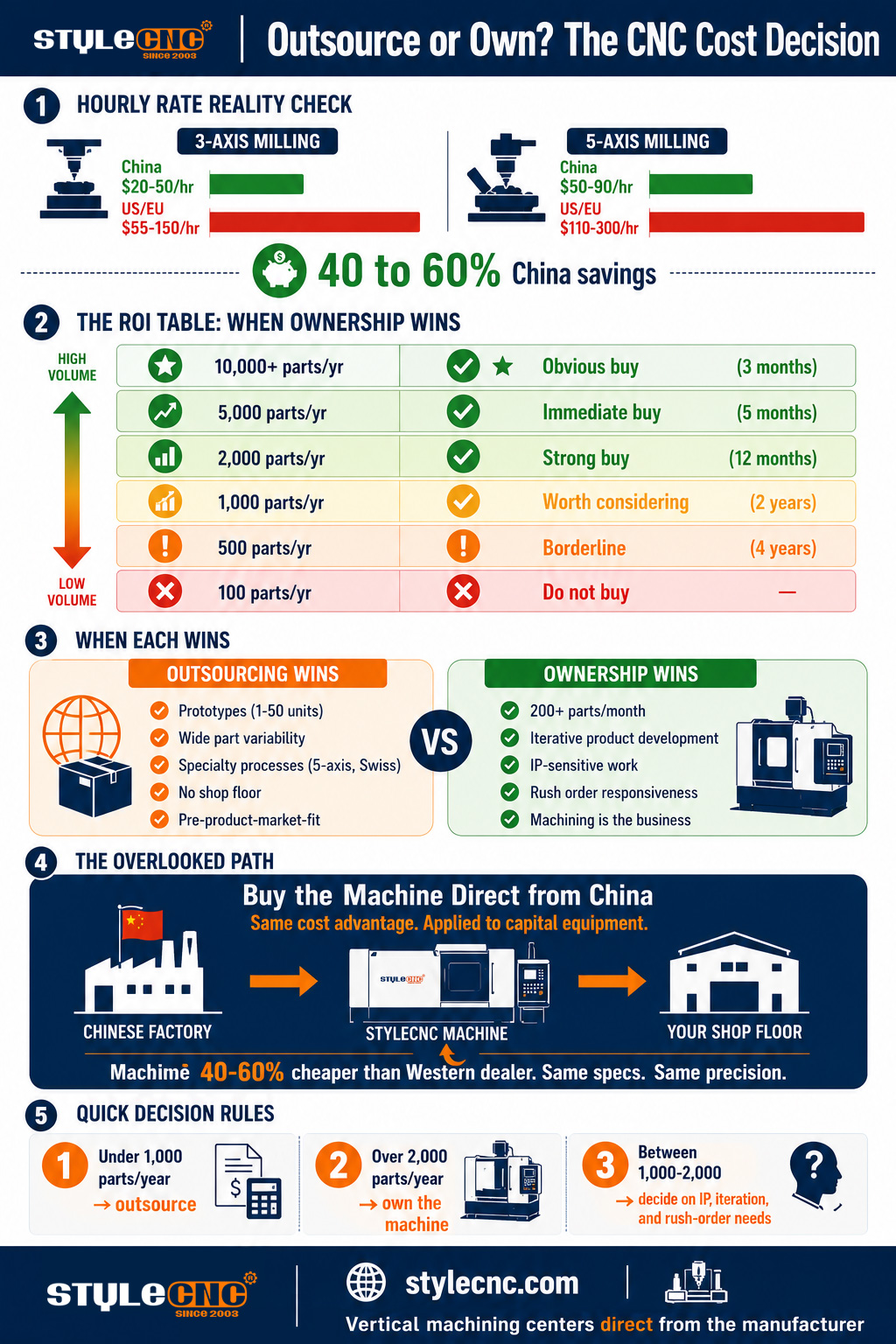
The hourly rates below reflect current industry benchmarks from Haizol, Davantech, Lewei Precision, JXD Machining, and other established Chinese CNC service providers. Rates cover machine time, operator labor, and factory overhead but exclude material, setup, tooling, finishing, and freight.
| Processo | China Rate (USD/hr) | US/EU Rate (USD/hr) |
|---|---|---|
| fresagem de 3 eixos | $20 para 50 | $55 para 150 |
| Fresagem de 4 eixos e 5 eixos | $50 para 90 | $110 para 300 |
| Torneamento CNC | $20 para 40 | $50 para 130 |
| Usinagem suíça | $50 para 90 | $120 para 250 |
| Fio EDM | $30 para 60 | $80 para 180 |
Per-part pricing follows a pattern. A typical aluminum 6061 milled bracket runs $20 to 55 in China versus $60 to 150 in the U.S., a 40 to 60 percent cost reduction on the machining line item. Volume matters significantly: 99.6 percent of Chinese suppliers offer multi-tier pricing, with average discounts of 37 percent between Tier 1 and Tier 2, and 54 percent between Tier 1 and Tier 3. Only 25 percent of buyers explicitly request tiered pricing, meaning most are leaving money on the table.
Hidden costs that add up: international fr8 ($50 to 300 for small orders, more for bulk), customs and duties (varies by country and material), payment and currency conversion fees, quality inspection third-party services if used, and communication overhead (time zones and translation).
Owning Your Own CNC Machine: The Full Cost Picture
Machine ownership includes capital cost, installation, tooling, materials, operator labor, electricity, consumables, maintenance, and eventual depreciation. The table below breaks down realistic numbers for a small-to-mid-size shop running a vertical machining center.
| Categoria de Custo | Faixa típica (USD) | Notas |
|---|---|---|
| Máquina (VMC from China) | 25,000 a 60,000 | Preços direto do fabricante |
| Máquina (VMC from US dealer) | 60,000 a 150,000 | Same specs, dealer markup + import |
| Instalação e comissionamento | 2,000 a 8,000 | Rigging, electrical, initial calibration |
| Starter tooling package | 3,000 a 10,000 | Toolholders, cutters, workholding |
| Operator labor (US) | $25 to 45/hour | Loaded rate with benefits and overhead |
| Eletricidade | $2 to 5/hour | 10 to 20 kW draw under load |
| Consumables (inserts, coolant) | $3 to 8/hour | Varies with material and cycle intensity |
| Manutenção e peças de reposição | 3 to 5 percent of machine cost annually | Preventive plus reactive |
| Depreciação | 10-year straight line typical | Tax treatment varies by jurisdiction |
The biggest cost lever in ownership is where you buy the machine. A vertical machining center bought direct from a Chinese manufacturer costs 40 to 60 percent less than the same-spec machine bought through a US or European dealer. Buyers who source parts from China but buy machines locally are effectively paying dealer markup twice, once on every part and once on their own machine.
The ROI Table: When Does Ownership Pay Back?
The comparison below assumes an aluminum bracket part with a China service price of $25 per part, in-house production cost of $10 per part (material, operator time, consumables, electricity), and machine cost of $30,000 for a vertical machining center bought direct from China. Adjust for your part economics.
| Volume anual | Custo da terceirização | Custo interno | Período de retorno |
|---|---|---|---|
| 100 parts/year | 2,500 USD | $1,000 + machine | 20+ years (do not buy) |
| 500 parts/year | 12,500 USD | $5,000 + machine | 4 years (borderline) |
| 1,000 parts/year | 25,000 USD | $10,000 + machine | 2 years (worth considering) |
| 2,000 parts/year | 50,000 USD | $20,000 + machine | 12 months (strong buy) |
| 5,000 parts/year | 125,000 USD | $50,000 + machine | 5 months (immediate buy) |
| 10,000+ parts/year | $250,000 + | $100,000+ + machine | 3 months (obvious buy) |
The break-even point where ownership starts winning is approximately 1,500 to 2,000 parts per year for typical aluminum machining. Above that, owned machines save real money every year. Below that, outsourcing remains the smarter capital allocation.
2 adjustments matter. First, higher-value parts (titanium, medical, aerospace) have larger per-part savings and lower break-even volumes. Second, buying the machine from a Chinese manufacturer instead of a Western dealer lowers the capital cost by 40 to 60 percent, which cuts break-even volume roughly in half.
When Outsourcing to China Makes Sense
Outsourcing is genuinely the right call in several situations. Ignore anyone who tells you otherwise.
✓ Protótipos e lotes de pré-produção: 1 to 50 units where setup, programming, and fixturing costs would overwhelm your own machine's economics. Chinese suppliers handle prototype work efficiently at competitive prices.
✓ Wide part variability: If your monthly production spans 20+ different part designs, each in low quantity, no single machine will run them efficiently. Service factories with racks of machines and 24-hour shifts handle mixed workloads better than a single owned unit.
✓ Specialty processes you cannot justify in-house: 5-axis, Swiss turning, wire EDM, and specialty finishing require capital and expertise that only pay back at high utilization.
✓ No shop floor to house equipment: Owned CNC needs 200+ square feet, 3-phase power, air compression, coolant handling, and chip management. Not everyone has that space or the appetite to build it.
✓ Business model still validating: Startups and product companies pre-product-market-fit benefit from paying for parts only when they need them. Capital tied up in a machine is capital not available for marketing or engineering.
When Buying Your Own Machine Wins
Ownership beats outsourcing in these situations, and the gap widens the longer the business runs.
✓ Consistent monthly volume above 100 to 200 parts: The math on repeat parts always favors ownership once volume is reliable. Every part becomes a savings against the outsourcing baseline.
✓ Iterative product development: Modifying a design, re-cutting, and testing on your own machine takes hours. The same iteration through a Chinese service takes days minimum. Speed compounds across a development cycle.
✓ Intellectual property sensitivity: Sending CAD files to any external supplier creates IP exposure. In-house machining eliminates that entire risk category, which matters for medical devices, defense-adjacent products, and proprietary industrial hardware.
✓ Rush order responsiveness: A part you need tomorrow can be running on your own machine in hours. From a Chinese service, even air-freighted, it takes 5 to 10 days. Customers pay premiums for that responsiveness.
✓ Building a machining business itself: If your company is a machining shop, owning the machines is not a comparison, it is the business. The only real question is what to buy and where.
The Hybrid Approach: Buy the Machine Direct from China
The most overlooked option in this comparison is that buyers who source parts from China can also source the machines from China, capturing the same cost advantage on capital equipment that they already capture on parts. This is the STYLECNC direct-from-manufacturer approach.
STYLECNC is a Chinese CNC machinery manufacturer that has served customers in 180+ countries since 2003. The centro de usinagem CNC vertical is the direct competitor to what Chinese CNC service factories are actually using to cut your parts. Same class of machine, same precision capability, priced at 40 to 60 percent below what U.S. and European dealers charge for equivalent specifications.
For higher-throughput production, the industrial CNC vertical machining center scales up envelope and rigidity for larger workpieces. For smaller shops and prototype-focused programs, the small CNC vertical milling machine e hobby CNC milling machine for metal bring machine ownership into a lower capital range without sacrificing precision.
For buyers unsure about pricing at each configuration tier, the CNC machine pricing comparison across Asia and Europe e Análise de custos de máquinas CNC para trabalhar madeira cover the direct-purchase economics with real pricing bands. The core message is simple: if the numbers say you should buy, buying from a Chinese manufacturer maximizes the ROI you already validated in the table above.
Glossary: CNC Service and Ownership Terms
Use this reference when reading service quotes, evaluating machine purchases, or comparing suppliers.
| INVERNO | Definição |
|---|---|
| RFQ | Request for Quotation. The CAD file plus specification package sent to CNC service suppliers to receive pricing. |
| DFM | Design for Manufacturability. Engineering review that identifies part features expensive to machine and suggests alternatives. |
| VMC | Vertical Machining Center. Standard 3-axis or 4-axis CNC mill with vertical spindle. The workhorse of most CNC shops. |
| Tier pricing | Volume-based discount structure. Tier 1 covers smallest orders; Tier 2 and 3 offer discounts for larger quantities. |
| Volume de equilíbrio | The annual production quantity at which owning a machine saves more than the machine cost, typically over 1 to 3 years. |
| Taxa de mão de obra carregada | Total cost of one operator hour including wages, benefits, taxes, and factory overhead. |
| O tempo de ciclo | The time required to produce one finished part on a machine, excluding setup and material handling. |
| ISO 9001 | International quality management standard commonly held by professional CNC service suppliers. |
| Custo inicial | Total delivered cost per part including machining, material, finishing, freight, duties, and payment fees. |
| Diretamente do fabricante | Purchasing equipment directly from the factory that builds it rather than through a distributor or dealer. |
Perguntas frequentes
How much cheaper is CNC machining in China compared to the US?
Chinese CNC hourly rates run 30 to 60 percent below U.S. and European benchmarks according to Davantech, Haizol, and JXD Machining industry data. A typical 3-axis milling job runs $20 to 50 per hour in China versus $55 to 150 in the U.S. Per-part savings on aluminum brackets are 40 to 60 percent. The cost difference comes from lower labor, lower overhead, and deeper local material supply chains, not from using different machines.
At what volume should I consider buying my own CNC machine?
Break-even against China service pricing typically lands around 1,500 to 2,500 parts per year for aluminum work, based on machine cost of $30,000 direct from a Chinese manufacturer and per-part savings of $15. Below 1,000 parts per year, outsourcing usually wins. Above 5,000 parts per year, ownership becomes obvious. The gray zone is 1,000 to 3,000 parts where other factors like IP, iteration speed, and rush orders shift the answer.
Can I buy the same machine that Chinese CNC services use?
Yes. Chinese CNC service factories run a mix of Fanuc, Mazak, Haas, Doosan, DMG MORI, and comparable machines from Chinese industrial manufacturers. Any of these can be bought direct. Chinese manufacturers like STYLECNC sell vertical machining centers, mills, and routers to end users worldwide at the same price tier the domestic service factories pay, plus international freight.
Do Chinese CNC machines meet Western quality standards?
Modern Chinese industrial CNC machines built to international specification and paired with FANUC, Siemens, or Mitsubishi controllers deliver the same precision as Western-built machines. Repeatability of plus or minus 0.005 mm is standard on quality machining centers regardless of country of manufacture. What varies more than country is machine class: entry-level machines vary widely; industrial-grade machines from established manufacturers deliver consistent results.
What are the hidden costs of outsourcing to China?
The main hidden costs are international fr8 ($50 to 300 for small orders, more for bulk), customs and duties in the destination country, payment fees and currency conversion, quality inspection if you use third-party services, and communication overhead across time zones. Landed cost including all of these is typically still 25 to 50 percent below domestic sourcing, but the gap is smaller than the hourly rate comparison suggests.
What is the lead time difference between service and in-house?
Chinese CNC service typical lead time is 2 to 4 weeks including production, quality inspection, and sea or air freight. Rush orders can compress to 7 to 14 days at premium rates. In-house production of the same part on your own machine takes hours to a day once the program is loaded and material is on hand. For iterative development, rush orders, or time-sensitive customer commitments, in-house speed compounds significantly.
STYLECNC Constrói centros de usinagem CNC verticais and adjacent industrial equipment for direct sale to global customers. To discuss whether the ROI math in this article points you toward a machine purchase, review the full CNC machining center catalog ou contate o STYLECNC team for a configured quote against your part list and volume forecast.